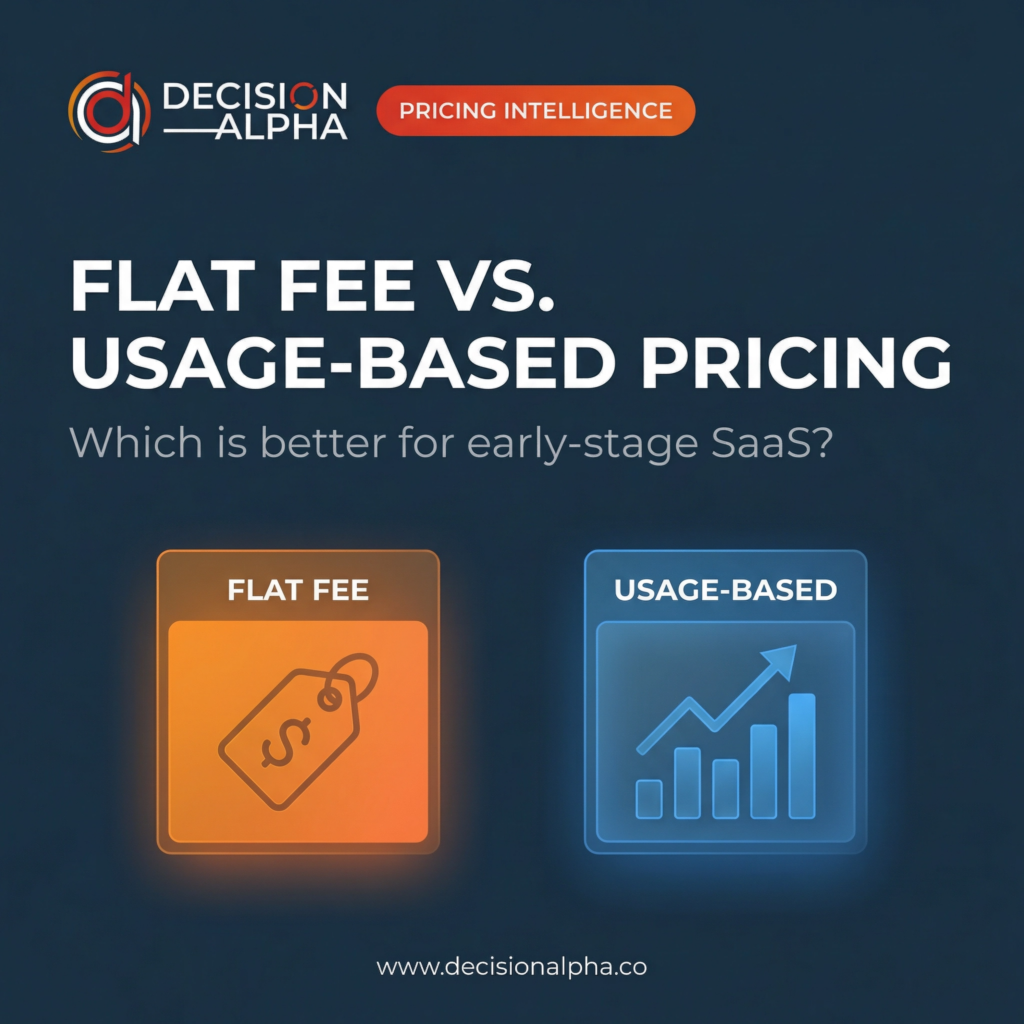
Flat Fee vs. Usage-Based Pricing: Which is Better for Early-Stage SaaS? For early-stage SaaS and beta products, you should start with a simple flat fee rather than usage-based pricing. Usage-based pricing introduces friction and anxiety for early users who do not yet know how much they will use your product. You should only evolve to usage-based tiers later, once clear customer segments and predictable usage patterns have emerged from your initial user base.
Think of it like going to a new restaurant. If you pay a flat fee for an all-you-can-eat buffet, you feel comfortable trying different dishes without worrying about the bill. But if you have to pay per bite, you will hesitate, constantly calculating the cost in your head, and likely eat less. Early-stage SaaS users need the “buffet” experience—they need the freedom to explore and integrate your tool into their workflow without a running meter causing anxiety.
The Anxiety of the Meter
When you launch a new product, your primary goal is adoption. You want users to log in, test features, and build habits around your software. Usage-based pricing (charging per API call, per credit, or per active user) actively discourages this behavior. It forces the user to make a purchasing decision every time they interact with your tool.
In behavioral economics, this is related to the pain of paying. When the cost is decoupled from the usage (like a flat monthly fee), the pain is felt once. When the cost is tied to every action, the pain is experienced repeatedly, creating a psychological barrier to adoption.
A Real-World Example: The Beta Launch
In a recent pricing audit for an early-stage B2B SaaS platform, the founders were debating between a flat monthly subscription and a usage-based model tied to the number of credits consumed by their AI tool.
Their instinct was that usage-based pricing felt “fairer” because customers only paid for what they used. But for a beta product, fairness is not the primary metric—adoption and data collection are.
If they charged per credit, a new user testing the system would be penalized for experimenting. If the user ran 50 test queries to see how the system worked, they would get a bill before they even saw the true value of the output. By recommending a flat fee for the beta phase, we removed the friction. Users could run as many queries as they wanted, allowing the founders to gather crucial data on how the product was actually being used in the wild.
When to Introduce Usage-Based Pricing
Usage-based pricing is highly effective for revenue expansion, but it is a scaling strategy, not a launch strategy. You should introduce it only when:
1.You have predictable data: You know what “normal” usage looks like versus “power” usage.
2.You can clearly segment users: You understand the difference between a small business user and an enterprise team.
3.Your value metric is clear: What you charge for perfectly aligns with the outcome the customer cares about (e.g., successful transactions, not just logins).
Once you have this data, you can confidently build usage-based tiers that capture the value of your heavy users while keeping the entry price accessible for smaller accounts.
Final Thought
Don’t let the desire for perfect monetization kill your early adoption. Start flat, gather data, and scale into usage-based pricing when the market tells you it’s ready.
FAQ
Should a beta product use usage-based pricing?
No. Beta products should generally use a flat fee to encourage exploration and adoption. Usage-based pricing creates friction that discourages early users from fully testing the software.
No. Beta products should generally use a flat fee to encourage exploration and adoption. Usage-based pricing creates friction that discourages early users from fully testing the software.
When is the right time to switch to usage-based pricing?
You should switch to usage-based pricing only after you have collected enough user data to understand average usage patterns, clearly identify different customer segments, and confidently define your core value metric.
You should switch to usage-based pricing only after you have collected enough user data to understand average usage patterns, clearly identify different customer segments, and confidently define your core value metric.
Why does usage-based pricing cause user anxiety?
Usage-based pricing causes anxiety because the user cannot accurately predict their final bill, especially when they are unfamiliar with the software. This uncertainty leads to restricted usage and lower engagement.
Usage-based pricing causes anxiety because the user cannot accurately predict their final bill, especially when they are unfamiliar with the software. This uncertainty leads to restricted usage and lower engagement.