One Price vs. Multiple Tiers: How to Structure Your Pricing

One Price vs. Multiple Tiers: How to Structure Your Pricing
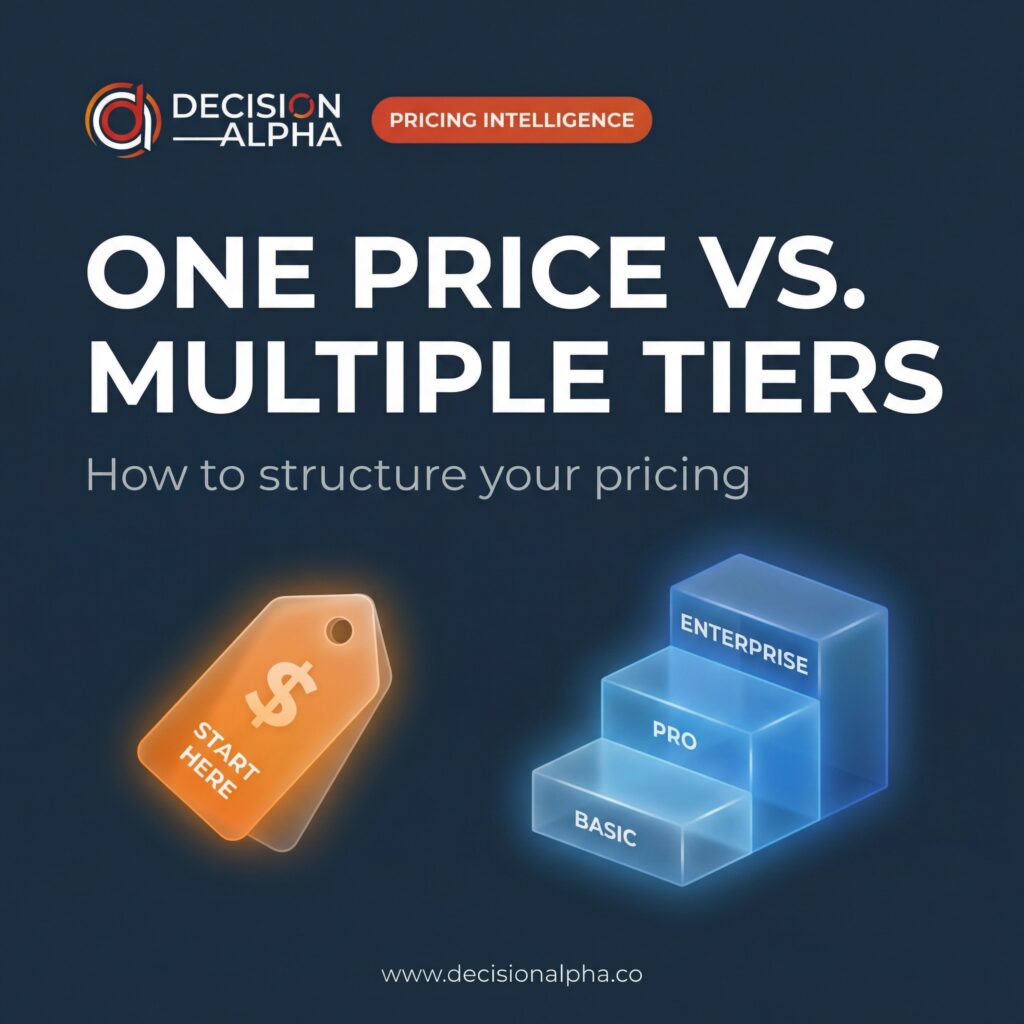
When structuring your pricing, offering multiple tiers is almost always better than presenting a single price. A single price forces the customer into a stark “yes or no” decision, which increases the likelihood of them walking away. By offering options—typically three—you shift the psychological question from “Should I buy this?” to “Which of these is right for me?” However, you must carefully limit the number of tiers to avoid cognitive overload.
Think of it like buying a car. If the dealership only sells one model with one set of features at one price, you will constantly compare it against every other car on the market to decide if it’s worth it. But if they offer a standard model, a sport model, and a luxury model, your brain naturally starts comparing the cars against each other. The options keep you engaged in the buying process rather than walking off the lot.
One price vs. multiple tiers: how to structure your pricing

The Psychology of Choice

In a recent pricing audit with an early-stage startup, the founders were launching their software with a single, flat price. They believed this would make the buying process as simple as possible. Instead, their conversion rates were abysmal.
The problem was that a single price point acts as an ultimatum. Without other options to provide context, the buyer has no internal reference point for value. We restructured their offering into three tiers: a stripped-down basic version, a core “pro” version, and a premium version with advanced integrations.
Almost immediately, conversions increased. Why? Because the premium tier made the core tier look like a sensible, safe choice (a concept known as the decoy effect). We didn’t just give them options; we guided them toward the option we wanted them to choose.

Managing Cognitive Overload

While options are good, too many options will paralyze your buyers. If you present a potential customer with five different tiers, each with a massive checklist of slightly different features, you trigger cognitive overload.
When buyers are confused, they do not choose the cheaper option—they choose to do nothing.
To structure your tiers effectively:
1.Stick to the rule of three: Three tiers is the psychological sweet spot. It provides enough contrast without overwhelming the buyer.
2.Differentiate by value, not just features: Each tier should clearly speak to a different type of user (e.g., “For Solo Founders,” “For Growing Teams,” “For Enterprise”).
3.Highlight the ideal choice: Visually emphasize the middle or “Pro” tier to give buyers a clear recommendation on where to start.

Final Thought

Don’t back your customers into a corner with a single price. Give them a choice, but curate those choices carefully to guide them toward a confident decision.

FAQ

Is it better to have one price or multiple pricing tiers?

It is generally better to have multiple pricing tiers. Offering options shifts the customer’s mindset from “Should I buy this?” to “Which one should I buy?”, which significantly increases the likelihood of a purchase.

How many pricing tiers should I offer?

Three pricing tiers is the psychological sweet spot. Offering three options allows you to capture different segments of the market and use the highest price to make the middle option look more attractive, without causing decision fatigue.

What happens if I offer too many pricing options?

Offering too many options causes cognitive overload. When customers are faced with a complex grid of too many choices, they become overwhelmed and often delay or abandon the purchase entirely.

© 2026 | 615 Channelside Drive, Tampa, FL 33602 | All rights reserved by Decision Alpha®

Let’s talk